Why I Deleted My OpenAI Account
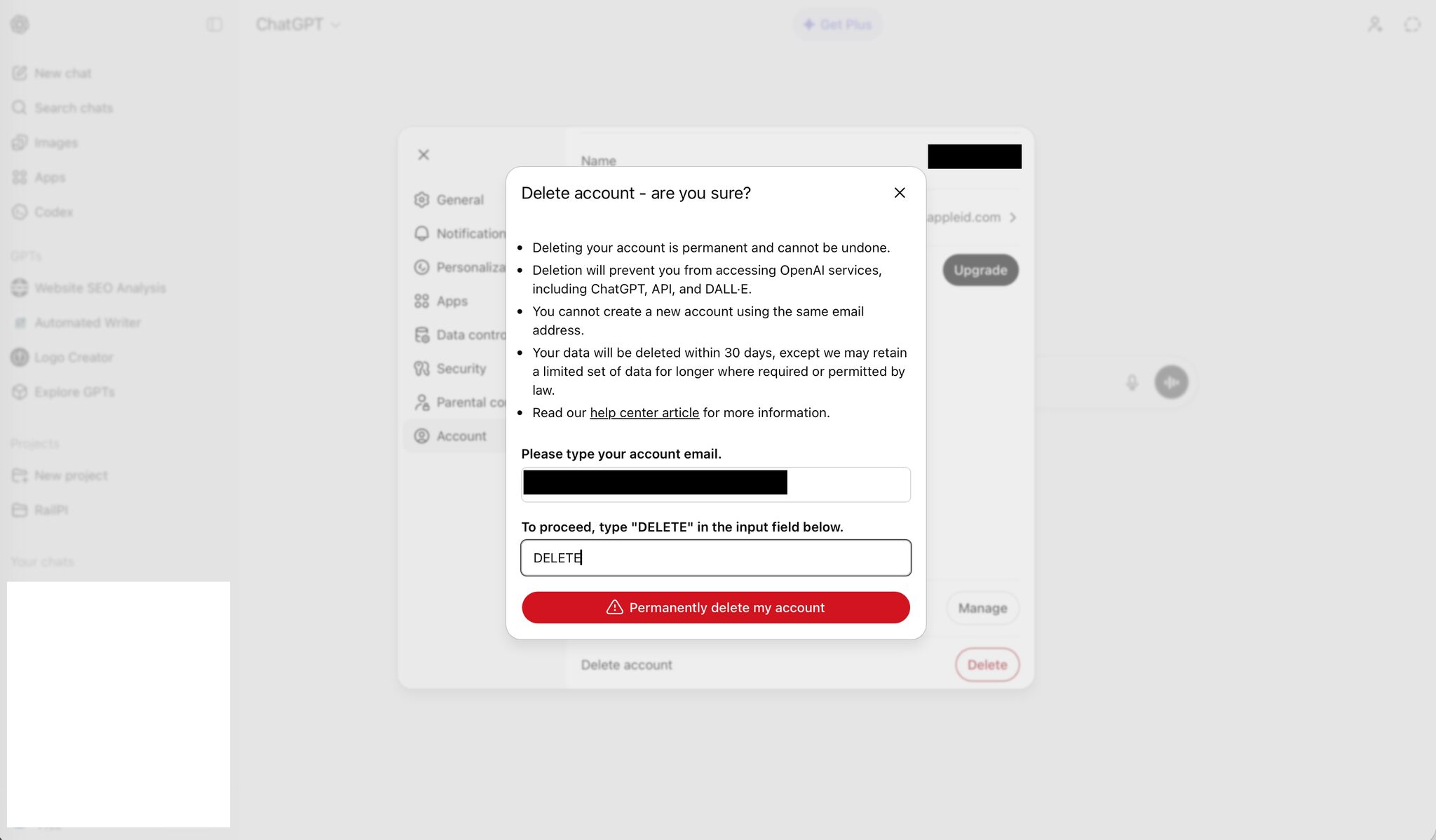
I deleted my OpenAI account last week. Not because I'm afraid of AI. I deleted it because the company's choices have real consequences for the clients I work with, and I can no longer pretend otherwise.
Op deze pagina
The money trail
In December 2024, OpenAI CEO Sam Altman personally donated $1 million to Donald Trump's inaugural fund. In September 2025, OpenAI president and co-founder Greg Brockman and his wife donated $25 million to MAGA Inc., the pro-Trump super PAC. That single donation was the largest in the committee's six-month reporting cycle, nearly a quarter of its total fundraising haul.
These are personal donations, not corporate ones. But Brockman is not just any person. He co-founded OpenAI. He is its president. When the president of your AI provider is the single largest donor to a political movement, that is material information. You should have it.
What happened in February 2026
On the 27th of February 2026, President Trump ordered all federal agencies to stop using Anthropic's AI immediately. The trigger: Anthropic had refused to remove restrictions on how the Pentagon could use Claude. Specifically, Anthropic would not allow its models to be used for mass domestic surveillance or fully autonomous weapons.
Defense Secretary Pete Hegseth called Anthropic's position 'arrogance and betrayal.' He designated the company a supply chain risk and announced that any contractor doing business with the U.S. military would be barred from using Anthropic's products commercially. Legal experts have since questioned whether the designation was lawfully executed. Anthropic has said it will sue if the threat is pursued.
Hours after the announcement, OpenAI signed its own deal with the Pentagon. Sam Altman said publicly that OpenAI shared the same 'red lines' as Anthropic, and had negotiated safeguards into the contract. Two days later, he admitted the deal had been rushed and 'looked opportunistic and sloppy.' OpenAI employees wrote open letters criticising the move. Chalk graffiti appeared on the pavement outside OpenAI's San Francisco offices: 'Where are your red lines?'
The result: Anthropic's Claude surged to the number one spot on both Apple's App Store and Google's Play Store in the days that followed. OpenAI secured a government contract.
How this affects your business
If you use ChatGPT, you are paying a company whose president is the single largest donor to a political movement that just used government power to punish a competitor for refusing to allow AI to be used for domestic surveillance. That is not a hypothetical risk. That is what happened last week.
Here is what else it means in practice.
Your data is not protected. OpenAI's terms of service grant the company a perpetual, irrevocable licence to use any input you provide. In 2023, Samsung banned employees from using ChatGPT after sensitive source code was leaked through the platform. If a multinational corporation cannot protect its data, your client strategy documents and draft contracts are not safe either.
The rules can change overnight. OpenAI's policy positions have shifted repeatedly. In 2024, they quietly updated usage policies to ban military applications, then reversed that position months later. The Pentagon deal was described by Altman himself as rushed. If you are building workflows on their tools, you are building on a platform where the rules are set by whoever is negotiating with the government that week.
The environmental cost is real. OpenAI has never published a carbon footprint for its operations. Researchers estimate that training a single large model produces emissions equivalent to five cars over their full lifetimes. If sustainability is part of your brand, ChatGPT is not consistent with it.
You are funding political influence at scale. OpenAI is also the top spender behind a $125 million AI super PAC designed to attack politicians who threaten to regulate the industry. The company has spent $50 million lobbying against state-level AI regulation. When you pay for ChatGPT, a portion of that money supports a campaign to ensure that the only oversight of AI tools like ChatGPT comes from the same administration that just banned a competitor for having safety standards.
The alternatives, honestly
The post circulating everywhere says 'just switch to Claude.' That is not quite right. Anthropic held a line that cost it government contracts and provoked the Trump administration into threatening its entire business. That is worth acknowledging. But Anthropic is still a for-profit company with venture capital funding and long-term commitments to ethical AI that remain unproven at scale. Claude is a better option than ChatGPT right now. Better is not the same as good.
For complete data sovereignty, local models are the real answer. Mistral, Qwen and Llama run on your own hardware. Your data does not leave your machine. The tradeoff is genuine: they require more prompt engineering and better hardware, and the outputs are less polished than GPT-4. For most solopreneur use cases, that tradeoff is worth making.
If you work with European clients, Euria runs on 100% renewable energy, publishes transparency reports including carbon data, and is GDPR compliant by design. It costs more per token. It also does not fund super PACs.
For tasks that actually matter, the right answer is often a person. I hired a freelance editor last month. She caught three errors in tone that GPT-4 missed, errors that would have undermined my credibility with a client. That is not a cost. That is an investment.
One thing you can do today
Run a seven-day experiment. Pick one task you currently use ChatGPT for. Replace it with one alternative: a local model, Euria, Claude, or a freelancer. Track time, cost, output quality, and how you feel about using it. At the end of the week, you will either have found a better option or you will know you are using OpenAI deliberately, rather than by default.
The point is not to be perfect. The point is to stop pretending the choice is neutral.
In the days since the Pentagon deal, users deleted ChatGPT and installed Claude in large enough numbers to move the App Store rankings. That is not nothing. That is what happens when people decide their choices matter.
Note: AI tools contributed to the drafting and research of this post.