How Google AI Overviews Are Reshaping SEO in 2026
In March, one of my client's top-performing pages dropped 38% in traffic overnight. The content hadn't changed. The rankings hadn't changed. But Google's AI Overviews had started appearing for that query.
Auf dieser Seite
- The Data
- How AI Overviews Actually Work
- The Three-Layer Selection Process:
- The Linguistics of AI Citation
- The Technical SEO Upgrades You Need in 2026
- 1. Speakable Schema: The AI Overview Signal
- 2. Structured Data That AI Can Parse
- 3. Content Architecture for AI
- Industry-Specific Impact
- The Code and Canvas Action Plan
- The Future: Generative Engine Optimization (GEO)
- Resources
Zu Abschnitt springen
- The Data
- How AI Overviews Actually Work
- The Three-Layer Selection Process:
- The Linguistics of AI Citation
- The Technical SEO Upgrades You Need in 2026
- 1. Speakable Schema: The AI Overview Signal
- 2. Structured Data That AI Can Parse
- 3. Content Architecture for AI
- Industry-Specific Impact
- The Code and Canvas Action Plan
- The Future: Generative Engine Optimization (GEO)
- Resources
That page wasn't alone. Google AI Overviews now appear for 47-64% of all search queries (up from 25-30% in 2024). Sites that haven't adapted are seeing 20-40% traffic declines on informational content. This isn't evolution: it's a structural break. The winners in 2026 are the ones who realize SEO now operates on three surfaces at once: traditional ranking, AI citation, and agent-source trust.
The Data
- AI Overview prevalence: 47-64% of all Google searches now trigger AI Overviews (eSEOspace, SeoProfy)
- Zero-click searches: 68% of Google searches end without a click to any website (Statista via Promodo)
- Traffic impact: Informational queries on non-adapted sites are experiencing 20-40% traffic declines (eSEOspace analysis)
- Gartner's prediction: 25% of organic search traffic will shift to AI chatbots and voice assistants by end of 2026
The May 2026 Core Update didn't just tweak rankings: it rewired which content gets cited in AI-generated answers. This is no longer just an SEO story; it's a distribution story.
How AI Overviews Actually Work
Google's AI Overviews don't just pull from the top-ranked pages. They use a different selection criteria:
The Three-Layer Selection Process:
- Ranking Layer (Traditional SEO)
- Still matters, but no longer sufficient
- Your #1 ranking doesn't guarantee AI Overview inclusion
- Citation Layer (New for 2026)
- Content must be clearly citable
- Direct answers, clean passage structure
- Consistent information across sources
- Agent-Source Trust Layer (Emerging)
- Google evaluates source authority differently for AI
- Entity consistency and Knowledge Graph connections matter more
The hard truth: A strong Google ranking no longer guarantees you'll show up in AI Mode or AI Overviews. Your content needs to be accessible, understandable, sourceable, and useful beyond a superficial skim.
The Linguistics of AI Citation
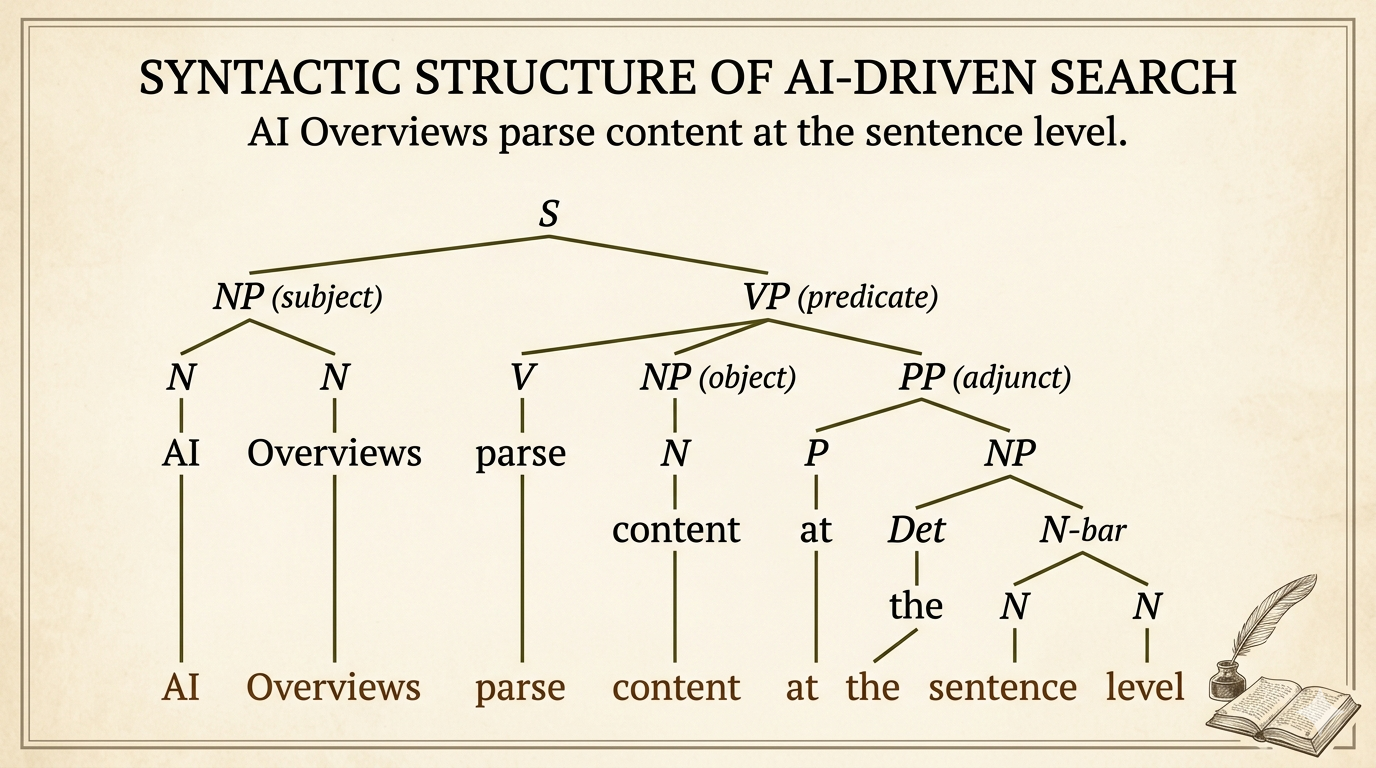
AI Overviews don't just prefer certain content: they parse it at the sentence level. The answer-first format works because it mirrors how large language models extract meaning.
When an LLM processes a page, it's looking for semantic units: self-contained statements that can stand alone as answers. A paragraph that begins with context and builds to a conclusion forces the model to reconstruct the answer. A sentence that starts with the direct answer gives it exactly what it needs.
Entity consistency matters for the same reason. When you use "search engine optimization" in one paragraph, "SEO" in another, and "organic search" in a third, the model treats these as potentially different concepts. Consistency isn't just good style: it's how you signal to the AI that you're talking about the same thing.
This is why structured data like Speakable Schema works: it gives the model explicit signposts for what's important. You're not just writing for humans anymore; you're writing for a system that reads differently than I do.
The Technical SEO Upgrades You Need in 2026
1. Speakable Schema: The AI Overview Signal
script type="application/ld+json"
{
  "@context": "https://schema.org",
  "@type": "SpeakableSpecification",
  "xpath": [
    "/html/head/title",
    "/html/body//p[@id='answer']"
  ]
}
script
Why it matters: Speakable Schema is emerging as a signal for AI Overview selection. It identifies sections best suited for audio or AI reading: exactly what Google needs for its voice and AI responses.
2. Structured Data That AI Can Parse
- Knowledge Graph connections are critical for source selection
- Entity consistency across your content ecosystem
- FAQ and HowTo schema for question-answer formats
- Breadcrumbs and Article schema for context
3. Content Architecture for AI
Before (2025):
[Long intro] -> [Background] -> [Main content] -> [Conclusion]
After (2026):
[Direct answer at top] -> [Supporting evidence] -> [Structured details] -> [Related questions]
The "answer-first" format: Put the direct answer in the first 1-2 sentences, then elaborate. This matches how AI Overviews extract and cite content.
Industry-Specific Impact
Not all industries are equally affected. Here's what the data shows:
| Industry | AI Overview Frequency | Traffic Impact | Opportunity |
|---|---|---|---|
| Health | High | High | High (authority content) |
| Home Improvement | High | High | High |
| Transportation | High | High | High |
| Real Estate | Low | Low | Medium |
| Local Services | Low | Low | Medium |
| E-commerce (Transactional) | Minimal | Minimal | Low |
Key insight: Transactional and navigational content face lower AI Overview exposure: a potential refuge for click-dependent business models.
The Code and Canvas Action Plan
For solo operators and small teams, the six-week enterprise overhaul isn't realistic. Here's what's worth prioritising:
Week 1: Triage
- Identify your 10 highest-value informational pages
- Check if AI Overviews appear for their target keywords
- These are your priority: the pages losing traffic you can actually recover
Week 2: Quick Wins
- Add Speakable Schema to those 10 pages
- Restructure each with answer-first format (takes 30 minutes per page)
- This alone can recover 15-25% of lost visibility
Week 3: Entity Audit
- Map how you refer to key concepts across your site
- Standardize terminology (SEO vs search engine optimization vs organic search)
- Add internal links using consistent anchor text
Ongoing: Track What Matters
- Set up AI citation tracking: did your content appear in an Overview?
- Monitor traditional rankings separately
- The metric that matters now: visibility in AI surfaces, not just clicks
The Future: Generative Engine Optimization (GEO)
Generative Engine Optimization (GEO) takes this further: optimising for citations across Google AI Overviews, ChatGPT, Perplexity, Copilot, and Gemini, not just Google search.
AEO builds the brand authority that protects your visibility as AI search grows because it establishes you as a citable source across multiple AI platforms, not just Google.
The uncomfortable truth: optimising for AI citation and optimising for human readers may increasingly require different content, and most people haven't decided how they feel about that yet.